
By Scott Bauer, Senior Executive Writer
Resume Place, Inc., August 18, 2026, Baltimore, MD.
Leadership Without the Title
A Three-Part Series on Writing Leadership That Gets Results
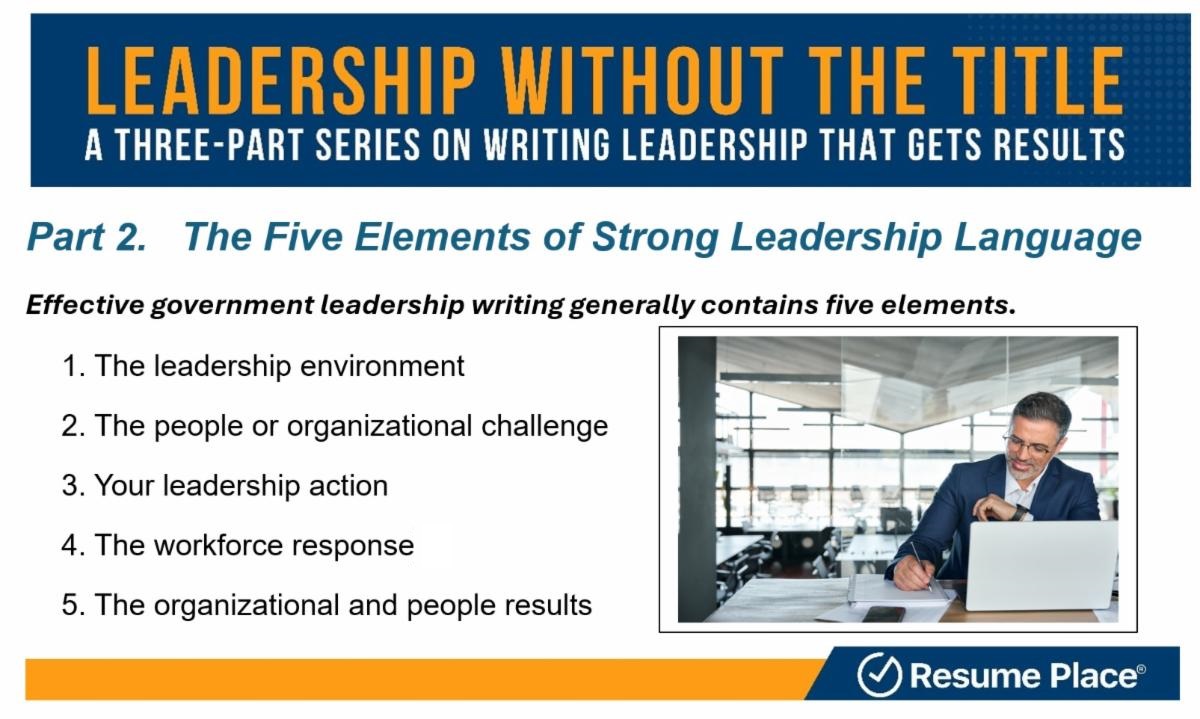
Part 2. The Five Elements of Strong Leadership Language
Effective government leadership writing generally contains five elements.
1. The leadership environment
Describe the scale and complexity.
Was the effort Department-wide, regional, cross-functional, multi-agency, politically sensitive, resource-constrained, or time-critical?
2. The people or organizational challenge
Explain what made the situation difficult.
Were employees disengaged? Was turnover increasing? Were stakeholders divided? Did the organization lack qualified successors? Were developmental opportunities distributed inconsistently? Was there resistance to change?
3. Your leadership action
Show what you personally did.
Did you establish the vision, build trust, coach employees, create accountability, negotiate a compromise, establish a development program, restructure responsibilities, or remove organizational barriers?
4. The workforce response
Explain how people responded to your leadership.
Did participation increase? Did employees volunteer for new responsibilities? Did offices adopt the process? Did leaders approve the approach? Did team members report greater confidence or clarity?
5. The organizational and people results
Explain what changed.
Quantify results when possible, but use measures that fit the story. Leadership metrics may include retention, promotion, engagement, participation, readiness, adoption, capability, collaboration, or succession strength.
Finding People Metrics in Your Own Experience –
Metrics Tell a Quick Story
Applicants often believe they have no people-centered data because they were not formally tracking retention or employee engagement.
In reality, useful evidence may already exist.
Consider whether you can identify:
- The number of employees who completed training
- The number who earned credentials or certifications
- The number who received developmental assignments
- The number promoted after participating in an initiative
- The percentage who remained with the organization
- The number of employees cross-trained
- The increase in mentoring participation
- The number of offices or employee groups represented
- The percentage of employees adopting a new process
- Changes in engagement or pulse-survey results
- The number of employees prepared to assume critical responsibilities
- The reduction in single points of failure
- The number of employees given exposure to senior leaders
- The number of first-time participants in an opportunity
- The increase in applicants for internal programs
- The expansion of access to field, remote, or previously underserved employees
Not every accomplishment will have a formal percentage attached to it.
Counts can also be powerful.
For example:
Created the first structured rotational program available to field employees, providing 18 employees from seven regional offices with developmental assignments and executive-level exposure.
That is a measurable leadership result, even without a survey or retention rate.
You can also use qualified language when exact data were not formally collected:
- Several participants later earned promotions.
- he program created the organization’s first succession pool for three mission-critical positions.
- Employee feedback reflected greater confidence in the new process.
- Leaders adopted the framework across all regional offices.
The language must remain truthful, but the absence of a percentage does not mean the absence of a result.
A Simple Test for Your Leadership Writing
After drafting an accomplishment, remove your title and organizational acronyms.
Then ask:
- Can the reader identify the people or organizational challenge?
- Can the reader tell what I personally did?
- Is there evidence that I influenced people or decisions?
- Did I develop capability in others?
- Did employees gain access to opportunities?
- Did the organization become less dependent on one person?
- Is the scale understandable outside my current Department?
- Can the reader see how people responded?
- Can the reader identify what improved because of my leadership?
- When those answers are clear, your writing is beginning to communicate leadership.
When the accomplishment still sounds like a position description, revise it.
Leadership Is a Pattern, Not a Position
The strongest federal leadership narratives do not depend solely on words such as “supervisor,” “manager,” or “executive.”
They reveal a pattern.
The candidate brings people together. The candidate makes sense of complexity. The candidate creates opportunities for others. The candidate builds trust. The candidate develops employees. The candidate expands organizational capability. The candidate accepts accountability and moves the mission forward.
That pattern can emerge at nearly any grade level and in nearly any occupational series. Your responsibility as an applicant is to make it visible.
Do not assume the hiring panel will recognize the leadership hidden inside unfamiliar acronyms, understated descriptions, or technical assignments. Translate the environment. Explain the challenge. Clarify your role. Show how you influenced others. Describe who developed, advanced, participated, remained, or became more capable because of your actions.
Leadership is not something a title gives you.
It is something your actions prove.
Your title tells the reader where you sat.
Your writing should show them how you led.
Too many federal employees have led complex initiatives, influenced senior leaders, developed colleagues, and solved difficult organizational challenges, yet their resumes make them sound like they simply attended meetings. This three-part series will help you translate your experience into compelling leadership accomplishments that increase your chances of being referred, earning an interview, and standing out in a competitive hiring process.
The journey does not end with the resume. Those same accomplishments become the foundation of your interview stories. By expanding them using the RP CCAR Builder, Challenge, Context, Actions, and Results, you can confidently demonstrate your leadership in both SES and non-SES interviews,
*****The journey does not end with the resume. Those same accomplishments become the foundation of your interview stories.******
READ MORE NEXT WEEK – 10 BEFORE & AFTER EXAMPLES OF LEADERSHIP LANGUAGE.
Part 3 – August 25, 2026 — 10 Before and After Examples of Leadership Language
Read Part 1 – Leadership Writing Articles here
If you have comments, if you would like to contribute to this article, or if you like this article, write to [email protected] I would appreciate your feedback. Kathryn Troutman, President, Resume Place, Inc.
Federal Resume Reviews/Consultation/Writing
Get professional help with your 2-page federal resume for the Program Analyst or any job series. Expert writing and coaching for project and accomplishment details; editing for 2 pages; analyzing the most important information for page one of the resume. Consultation is $210 or $260 (target GS 14 and up positions). Your career might depend on professional writing and targeting your federal resume.
ORDER EXECUTIVE $260 CONSULTATION HERE
Career Counselors – Get Certified to Teach
Ten Steps to a Federal Job®
 Based on the Ten Steps to a Federal Job® method, Kathryn Troutman and Resume Place, Inc., manage and teach a train-the-trainer Certified Federal Job Search Trainer® / Certified Federal Career Coach® program. The CFJST / CFCC has been taught for 24 years to employment readiness, career counselors and transition counselors. The Ten Steps curriculum is taught at military bases and job centers worldwide to help military and spouses begin Federal government careers. Information on the curriculum, 2026 dates here, and rates here.


