
By Scott Bauer, Senior Executive Writer, Resume Place, Inc.
Resume Place, Inc., August 9, 2026, Baltimore, MD.
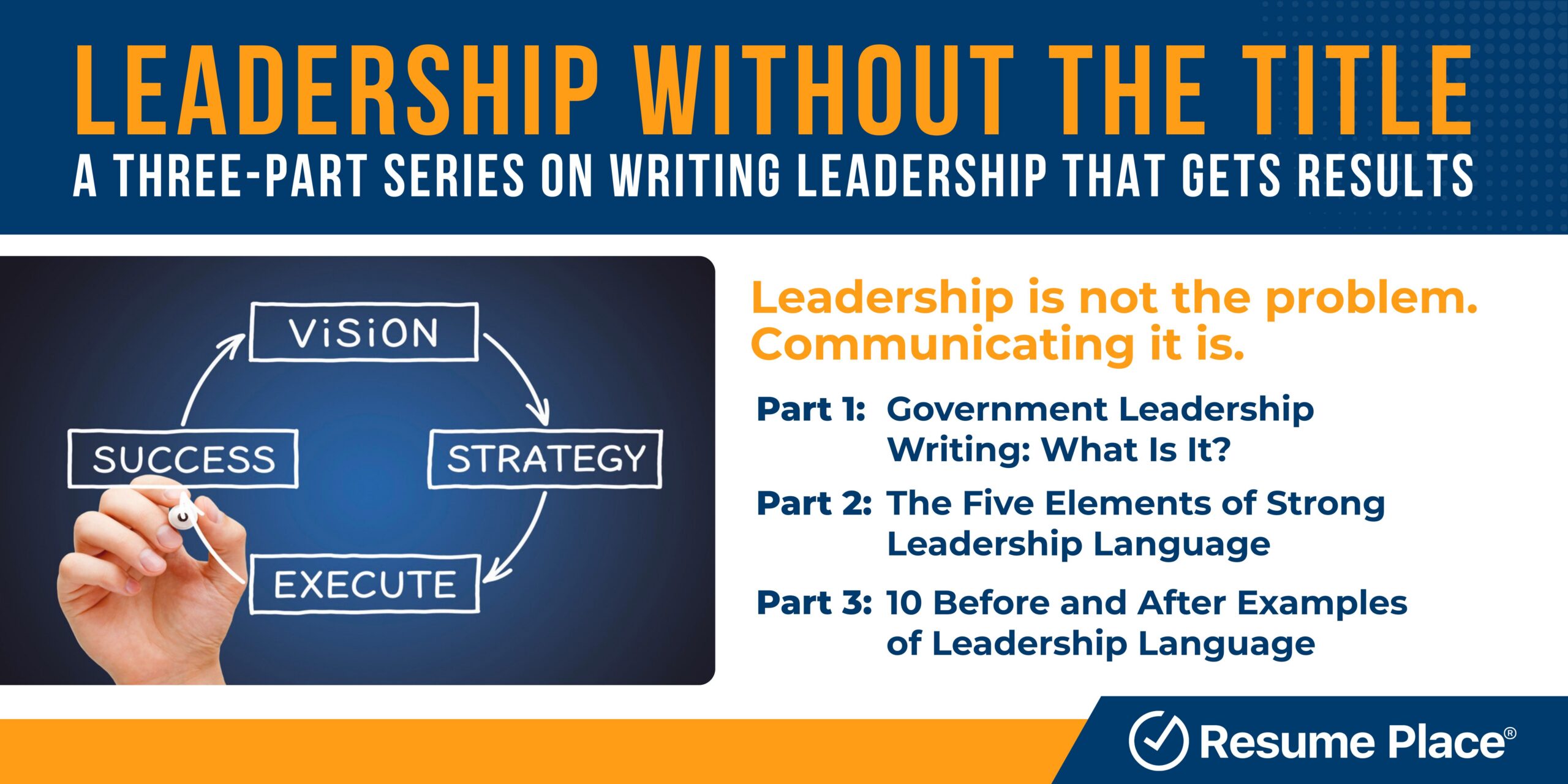
Leadership Without the Title
A Three-Part Series on Writing Leadership That Gets Results
Series Overview
Leadership is not the problem. Communicating it is.
Too many federal employees have led complex initiatives, influenced senior leaders, developed colleagues, and solved difficult organizational challenges, yet their resumes make them sound like they simply attended meetings. This three-part series will help you translate your experience into compelling leadership accomplishments that increase your chances of being referred, earning an interview, and standing out in a competitive hiring process.
The journey does not end with the resume. Those same accomplishments become the foundation of your interview stories. By expanding them using the RP CCAR Builder, Challenge, Context, Actions, and Results, you can confidently demonstrate your leadership in both SES and non-SES interviews
Part 1 – August 11, 2026
Government Leadership Writing: What Is It?
Before you can write compelling accomplishments, you must understand what leadership writing actually is. This article explains why so many federal employees unintentionally undersell themselves by describing activities instead of influence. Learn how to translate your experience into leadership that hiring managers can immediately recognize, whether or not you have held a formal supervisory position.
Part 2 – August 18, 2026
The Five Elements of Strong Leadership Language
Once you understand leadership writing, it is time to build it. This article introduces a practical framework for writing accomplishments that demonstrate leadership. Learn how to describe the environment, explain the challenge, highlight your personal actions, capture the workforce response, and showcase meaningful organizational and people results using metrics that strengthen both your resume and your interview stories.
Part 3 – August 25, 2026
10 Before and After Examples of Leadership Language
Now see the framework in action. This article walks through ten real world before and after examples that transform ordinary accomplishment statements into compelling leadership narratives. Learn how small changes in language can dramatically improve the way your experience is understood by hiring managers and interview panels.
Learning Journey
Part 1: Understand what leadership writing is.
Part 2: Learn the framework for writing it.
Part 3: See the framework applied through real examples.
Part 1. Government Leadership Writing: What Is It?
Federal résumés have a strange way of turning leaders into furniture.
A candidate may appear in every important room, sit beside every major decision, and be present for every critical moment, yet the writing makes that person sound as though they contributed no more than the conference table.
People who calmed a crisis, united competing offices, persuaded skeptical executives, coached future supervisors, and carried struggling initiatives across the finish line often reduce their experience to phrases such as:
- Supported leadership
- Assisted with implementation
- Participated in a working group
- Coordinated meetings
These phrases may accurately describe the setting, but they do not reveal the candidate’s influence. They place the person in the room without explaining what the person changed, solved, shaped, or moved forward. By the time the hiring panel finishes reading, the leadership has faded into the background.
The candidate who aligned six organizations sounds like someone who merely attended the meetings. The employee who developed an entire team sounds like someone who occasionally answered questions. The person who stepped into uncertainty, created direction, and earned the trust of others sounds like administrative support. The résumé tells the reader where the candidate sat, but it does not show how the candidate led.
This is not usually an experience problem. It is a translation problem.
Government leadership writing is the ability to make leadership visible. It translates your experience into evidence that you influenced people, shaped decisions, developed others, navigated resistance, created alignment, and improved the organization.
That translation is especially important for federal employees who have not yet held a formal supervisory title. Leadership does not begin when the word “supervisor” appears on your position description. It begins when people move forward because of your judgment, initiative, credibility, or influence.
Translation is equally important when applying to another federal Department. Every Department has its own dialect, filled with acronyms, organizational titles, governance bodies, programs, and workforce terminology. Experience that sounds significant inside your current organization may be difficult for someone outside it to understand. Your writing must explain the scope, stakes, people, and outcomes in language that allows any hiring panel to recognize the leadership involved.
A strong résumé should do more than prove that you were present. It should show how you brought competing offices together, influenced a difficult decision, developed employees, created direction when none existed, or moved an important effort forward.
Do not let your résumé turn you into part of the furniture, visible in every important room but credited with none of the progress. Make it clear that you did more than occupy a seat. Show the reader how your leadership changed what happened inside the room.
Leadership Is Larger Than Supervision
One of the most persistent myths in federal hiring is that leadership experience begins when someone becomes a supervisor.
Supervision is one form of leadership, but it is not the only form.
Supervisors possess formal organizational authority. They may assign work, evaluate performance, approve leave, address conduct issues, and make personnel recommendations.
Leadership is broader. It is the ability to influence people, shape direction, develop capability, create alignment, and move an organization toward an outcome.
You may be demonstrating leadership when you:
- Lead a cross-functional working group
- Coordinate action across multiple offices
- nfluence a senior leader’s decision
- Develop a policy or enterprise-wide process
- Resolve disagreements among stakeholders
- Represent your organization in a Department-level forum
- Mentor colleagues or prepare employees for advancement
- Create developmental assignments or learning opportunities
- Lead implementation of a new system or requirement
- Identify an organizational risk and mobilize others to address it
- Take ownership of a problem beyond your formal duties
The critical leadership question is not simply:
“How many employees reported to you?”
A more revealing question is:
“Who became more capable, confident, engaged, or better aligned because of your leadership?”
Perhaps employees gained access to training that had previously been unavailable. Maybe team members earned certifications, received promotions, or became ready for more complex assignments. Perhaps turnover declined, participation increased, collaboration improved, or employees reported greater confidence in leadership.
These are leadership outcomes.
They may be less visible than dollars saved or processing time reduced, but they often reveal more about a candidate’s ability to lead people.
Leadership Results Are Not Always Financial Results
Federal applicants are frequently taught to quantify accomplishments through cost savings, budget execution, workload volume, or processing time.
Those measures are valuable. But leadership accomplishments should also explain what happened to the people involved.
A process may have become 30 percent faster. But did employees understand the change? Did they adopt it? Did it reduce frustration or rework? Did the organization develop internal expertise, or did it simply complete another project?
Leadership results may include:
- Improved employee retention
- Increased promotion or internal placement rates
- Greater participation in development programs
- Increased professional certifications
- Improved employee engagement scores
- Increased succession readiness
- Broader access to developmental opportunities
- Improved onboarding completion
- Reduced burnout or workload imbalance
- Increased confidence in leaders or organizational processes
- Greater cross-training and bench strength
- Increased employee ownership of decisions
- Improved collaboration across organizational boundaries
- More employees prepared for mission-critical positions
- Reduced dependence on a small number of subject-matter experts
When possible, combine organizational results with people results.
For example:
“Reduced processing time by 25 percent while cross-training 18 employees, eliminating two single points of failure, and preparing four team members for expanded responsibilities.”
The processing improvement is important; the development of the workforce is leadership.
*****Stop Writing Like a Participant******
Many federal applicants unintentionally minimize their leadership by writing as though they merely attended, assisted, coordinated, or supported an effort.
Consider these common UNIMPRESSIVE passive voice phrases:
DON’T TYPE THESE WORDS!
- Participated in a working group
- Assisted with policy development
- Helped implement a new system
- Supported senior leadership
- Coordinated meetings
- Served as the office representative
- Tasked to implement and design
- Responsible for planning and coordination
These statements may be accurate, but they do not explain the candidate’s contribution, influence, judgment, or effect on others.
Government leadership writing goes deeper.
Instead of stating that you “participated,” explain what you contributed and how the group moved because of your involvement.
Instead of saying that you “supported leadership,” identify the analysis, recommendation, or strategy you provided and how it influenced the decision.
Instead of saying that you “coordinated meetings,” explain how you used those meetings to establish accountability, resolve disagreement, develop employees, or create organizational alignment.
Leadership writing requires the applicant to move beyond describing the activity and explain their role in shaping the outcome.
Do not just tell the reader what the team was doing; show what you personally influenced, changed, solved, or made possible.
Translate Your Leadership Across Departments
Another challenge arises when applicants move between federal Departments or agencies.
Every organization has its own language.
A term that is immediately understood in one Department may be unfamiliar–or may mean something entirely different–in another. Acronyms, governance structures, workforce terminology, budget processes, occupational titles, and organizational levels can vary significantly.
You may know exactly what an ERB, IPT, A1, J8, PMO, BPR, SESCDP, CFCM, or functional community does.
The reviewer may not.
The goal is not to remove every acronym. The goal is to ensure that agency-specific language does not conceal your leadership experience.
Department-specific version:
Led the A1 IPT supporting implementation of the MAJCOM civilian force development construct.
Translated leadership version:
Led a cross-functional human capital team representing headquarters and major field organizations to design and implement a Department-wide civilian development framework serving 12,000 employees.
A stronger version might also add the people result:
Led a cross-functional human capital team representing headquarters and major field organizations to design and implement a Department-wide civilian development framework serving 12,000 employees; increased participation in developmental programs by 28 percent and expanded succession slates for mission-critical positions from one qualified candidate per position to an average of three.
Now the reader can see not only what the candidate implemented, but how the workforce changed.
When translating experience, ask:
- What did the organization, program, or acronym actually do?
- Who were the major stakeholders?
- What level of the organization was affected?
- How many employees, offices, regions, or organizational components were involved?
- What leadership challenge did I face?
- What action did I personally take?
- How did employees, teams, or leaders respond?
- What became possible because of the effort?
Acronyms describe the environment; they should never carry the entire story.
Write for the Department You Want to Join
Strong applicants do more than define unfamiliar terms. They translate their experience into language that is meaningful to the target organization.
Suppose your current Department refers to an activity as “force development,” while the Department you are applying to uses “talent development,” “career development,” or “leadership development.”
You do not need to erase the original terminology. You should connect it to the target Department’s language.
For example:
Directed a Department-wide force development initiative, comparable to enterprise talent and career development programs, to strengthen succession planning and prepare employees for mission-critical roles.
A more results-oriented version might read:
Directed a Department-wide force development initiative serving 8,500 employees, increasing enrollment in career development programs by 35 percent, expanding mentoring participation from 90 to 240 employees, and preparing 46 employees for promotion or placement in mission-critical roles.
This approach demonstrates two things:
First, you understand the significance of your own experience.
Second, you understand how that experience applies to the organization you hope to join.
Do not make the hiring panel perform the translation for you.
Look for Part 2 coming August 18
If you have comments, if you would like to contribute to this article, or if you like this article, write to [email protected] I would appreciate your feedback. Kathryn Troutman, President, Resume Place, Inc.
Federal Resume Reviews/Consultation/Writing
Get professional help with your 2-page federal resume for the Program Analyst or any job series. Expert writing and coaching for project and accomplishment details; editing for 2 pages; analyzing the most important information for page one of the resume. Consultation is $210 or $260 (target GS 14 and up positions). Your career might depend on professional writing and targeting your federal resume.
ORDER EXECUTIVE $260 CONSULTATION HERE
Career Counselors – Get Certified to Teach
Ten Steps to a Federal Job®
 Based on the Ten Steps to a Federal Job® method, Kathryn Troutman and Resume Place, Inc., manage and teach a train-the-trainer Certified Federal Job Search Trainer® / Certified Federal Career Coach® program. The CFJST / CFCC has been taught for 24 years to employment readiness, career counselors and transition counselors. The Ten Steps curriculum is taught at military bases and job centers worldwide to help military and spouses begin Federal government careers. Information on the curriculum, 2026 dates here, and rates here.


